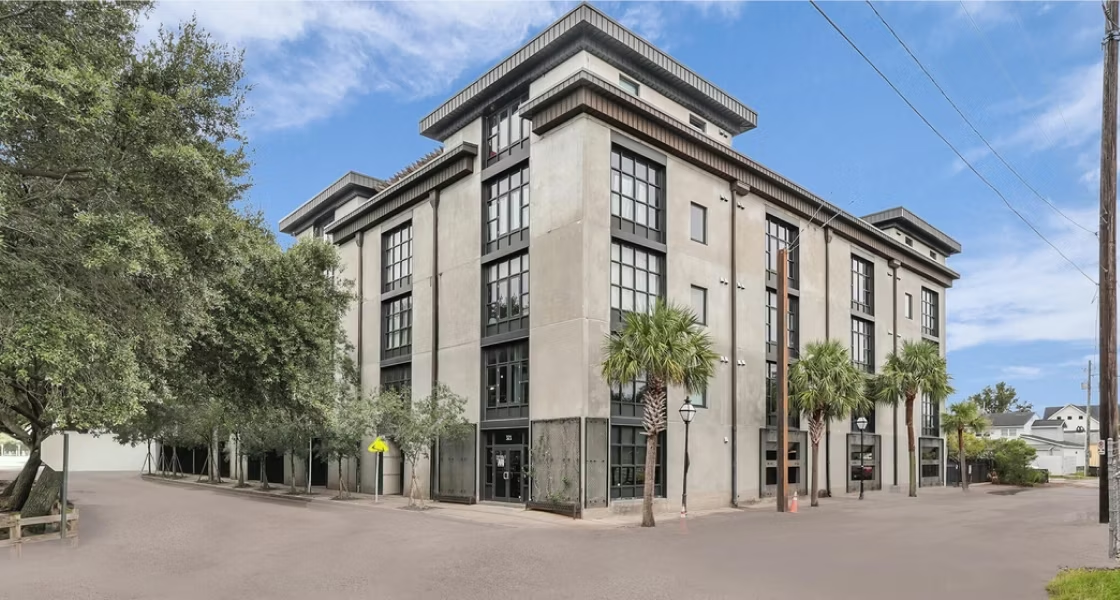
New Jersey's Newly Constructed Multiple Dwellings Law exempts qualifying new construction from municipal rent control for thirty years from completion, or for the initial mortgage's amortization period where that period is shorter. A building that qualifies underwrites at market rents because of that exemption. The statute attaches two conditions to the exemption.
A later owner can't claim the exemption if the developer missed the pre-certificate filing. The current owner also carries the burden of proving the developer filed, so evidence that the building is new construction isn't enough on its own.
An Appellate Division panel decided Willow Ridge Apartments v. Union City Rent Stabilization Board on July 7, 2022, holding that the filing under N.J.S.A. 2A:42-84.4 is a prerequisite to the exemption and that the owner has to prove it was made. The opinion is unpublished, so it isn't binding precedent. The statute it applies binds every owner, so the exemption is a claim the current owner has to document with records somebody else created.
Jersey City can now look at a building's rent control status without waiting for a tenant, because Mayor James Solomon's executive order of January 22, 2026 directed a citywide rent control compliance audit that can start independently of tenant complaints. So a building whose exemption has never been tested can be tested now.
Tenants at the Towers at Portside in Jersey City took the exemption to the city's Rent Leveling Board, arguing the original owners missed the filing. The board ruled 6-0 in October 2023 that both towers are subject to rent control.
Tenants then filed a federal class action on July 2, 2024, seeking $400 million. The complaint says the west tower's certificate of occupancy issued on August 25, 1992 and the exemption claim letter is dated November 23, 1994, more than two years later.
If the exemption fails, the building falls under the town's rent control ordinance, and that ordinance decides what happens to rent already collected above its limits. The state statute doesn't set a remedy. If the exemption holds, the rents are market and the file underwrites normally.
Nobody outside the deal can size what a failed exemption would cost, because the defect, where one exists, dates from before the first lease.
Brick City Capital asks for three documents before it treats the rents on an exempt building as market, so ask the seller for them before the file comes in. All three are historical and none can be produced after the fact. A seller who developed the building will have them. A seller who bought it in 2019 may never have seen them, and a seller who can't produce them can't prove the exemption.
Newark runs the same thirty-year-or-amortization exemption under section 19:2-18.1 of its municipal code. A Newark landlord applies to the Rent Control Board after the certificate of occupancy issues and before any tenant moves in, with a copy of the certificate and the initial rent. The exemption is deemed granted if the Board doesn't show within 30 days why the landlord isn't eligible, so on a Newark building, ask for that application and anything the Board sent back.


Our headquarters
50 Park Place, Suite 301
Newark, NJ 07102
loan products