Exit a Maturing Bridge Loan Before Default Interest Hit 24%
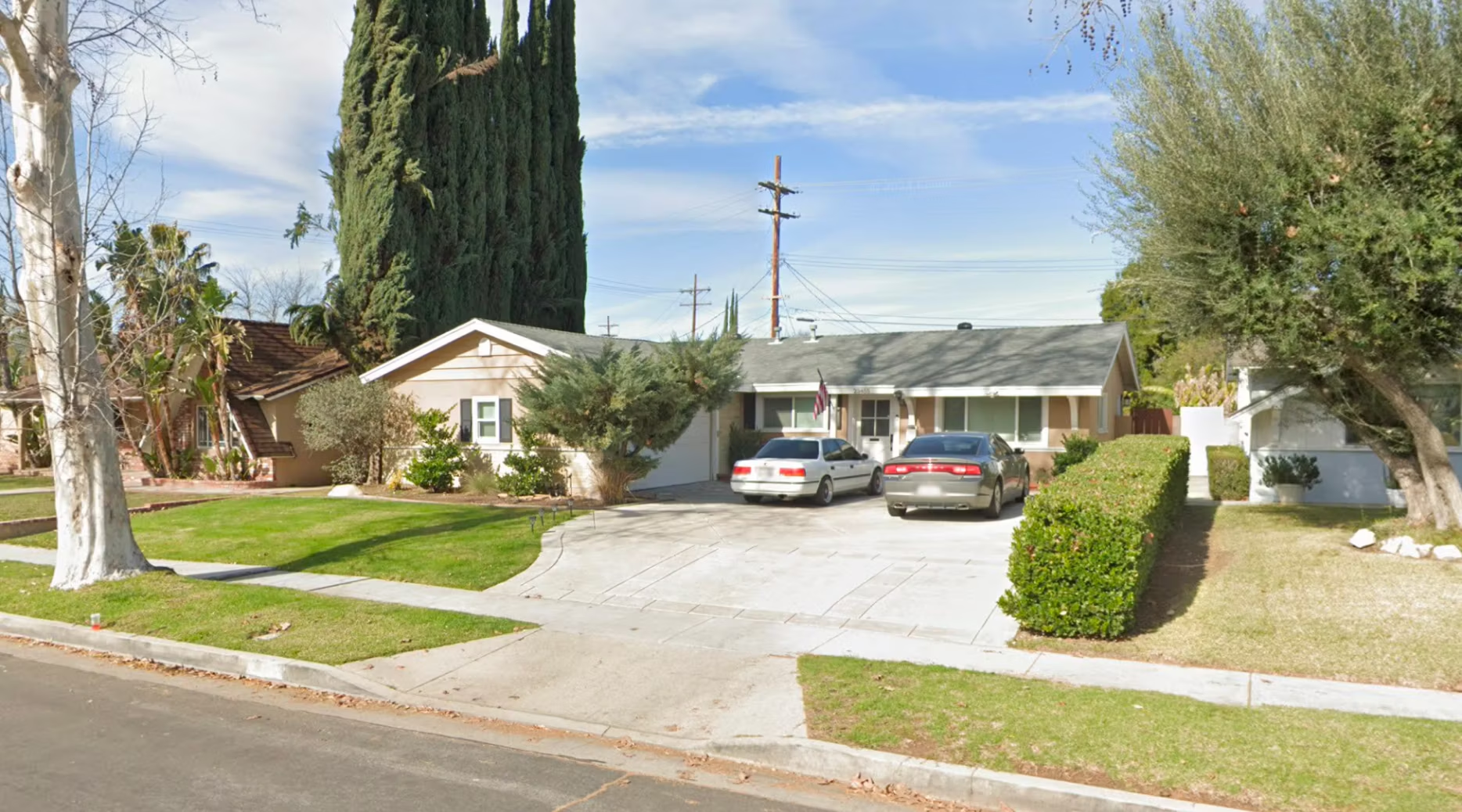
The borrower owned a single-family property in West Hills, Los Angeles, with two newly built accessory dwelling units, a value-add project executed on a bridge loan. The construction was done. The ADUs were complete. The plan was the standard playbook: build the units on short-term money, then refinance into long-term fixed-rate debt once the value was in place.
The refinance needed to do three things at once: pay off the maturing bridge loan, clear mechanics and solar liens sitting on the property, and lock the borrower into a permanent structure with payment flexibility. The target was a 75% LTV rate-and-term refinance: 10 years of interest-only payments, then a 20-year amortization, all on a 30-year fixed structure.
The bridge loan was approaching maturity. If the refinance didn't close in time, the loan would balloon, late fees would stack, and default interest at 24% would start compounding against the borrower. Every week of delay was real money.
One ADU Is Financeable Almost Anywhere. Two ADUs Killed This Deal at the Last Lender.
Accessory dwelling units have become a core value-add strategy in California, and lenders have adapted up to a point. A single-family property with one ADU fits most non-QM guidelines cleanly. A single-family with two ADUs is a different animal. Typical guidelines don't extend to two units, largely because there are far fewer comparable sales. Without comps, appraisers can't support the value, and without supported value, lenders can't underwrite the LTV.
That's exactly where this deal died at the previous lender. They ordered the appraisal, saw the two-ADU configuration, and couldn't get comfortable. The value was there. Their process simply had no way to prove it.
The failed attempt created a second complication. The borrower had already paid for an appraisal at the prior lender, and the maturity clock hadn't stopped ticking. Starting over with a new appraisal order meant more cost and more time. Transferring the existing appraisal was a requirement for the deal to work at all.
Guidelines stop at one ADU. Fewer comps means unsupported value, and the deal is killed.
Bridge loan matures. Balloon payment comes due. Late fees stack and default interest hits 24% while the borrower searches for a third lender.
Prior Lender Outcome
24%
Default Interest Risk
Researched the market and found comparable two-ADU properties. Value supported at the full 75% LTV.
Comps came back strong enough to support the full $1.8M value instead of the projected $1.75M, increasing the loan amount by $37,500.
Brick City Capital Result
+$37.5K
Above Structured
Have an ADU property another lender couldn't get comfortable with?
Multiple ADUs, thin comps, a maturing bridge loan. If the value is real, there's usually a way to support it. Submit your scenario before the clock runs out.
Do the Due Diligence Before Committing. Then Move Everything at Once.
Instead of seeing two ADUs and declining, the team asked whether comparable two-ADU properties existed in the market. If they did, the value could be supported and the deal could close. If they didn't, better to know before making promises.
The comps existed. The team found comparable properties with the same two-ADU configuration in the area, which meant the transferred appraisal could be supplemented with market evidence supporting the full value. That research happened up front, before the borrower was told yes, so the yes could actually be delivered.
From there, everything ran in parallel. While the appraisal transfer processed, all borrower documentation was reviewed ahead of time. Nothing sat in a queue waiting for something else to finish.
WEEK 1
Appraisal Transferred, Two-ADU Comp Added
The existing appraisal was transferred from the prior lender, a hard requirement given the maturity timeline. A comparable property with the same two-ADU configuration was added to support the full value at 75% LTV. No new appraisal order, no new appraisal fee, no lost weeks.
WEEK 2
Documents Reviewed, Underwriting Cleared
All borrower documentation was reviewed while the appraisal transfer processed. Underwriting cleared the file with the comp-supported value, and the comps came back strong enough to support the full $1.8M value rather than $1.75M.
DAY 21
Closed Better Than Structured
- $1,350,000 funded at 75% LTV, 30-year term
- 10 years interest-only, followed by 20-year amortization
- Loan amount increased $37,500
- Maturing bridge loan paid off
- Mechanics and solar liens cleared at closing
Most lenders run one formula. If the deal breaks the formula, they don't do the deal.
The ADU boom in California has produced a growing class of properties that outperform their guidelines. Investors are adding second units because the economics work: more doors, more rent, more value on the same lot. But lending guidelines were written for the properties that existed before the strategy took off, and most stop at one ADU. The result is a market full of legitimately valuable assets that die in underwriting for no reason other than configuration.
The two-ADU problem is really a comps problem, and comps problems are solvable with work. Finding that evidence took research and a team confident enough to commit based on what they found. That's the difference between a formula and an underwrite.
It's also worth noting what the extra work produced: not just a closed deal, but a better one. The comps supported more value than projected, and the borrower's loan amount went up $37,500 at the table. The same diligence that saved the deal improved it.
$37,500
Additional proceeds at closing because the comps supported more value than the original structure assumed.

"We did our due diligence ahead of time, researched our own comps, and having the confidence in the team to find those comps is what let us do the deal in the first place. We closed it even better than originally structured."