Putting Idle Equity to Work Before Acquisition Deadlines Hit
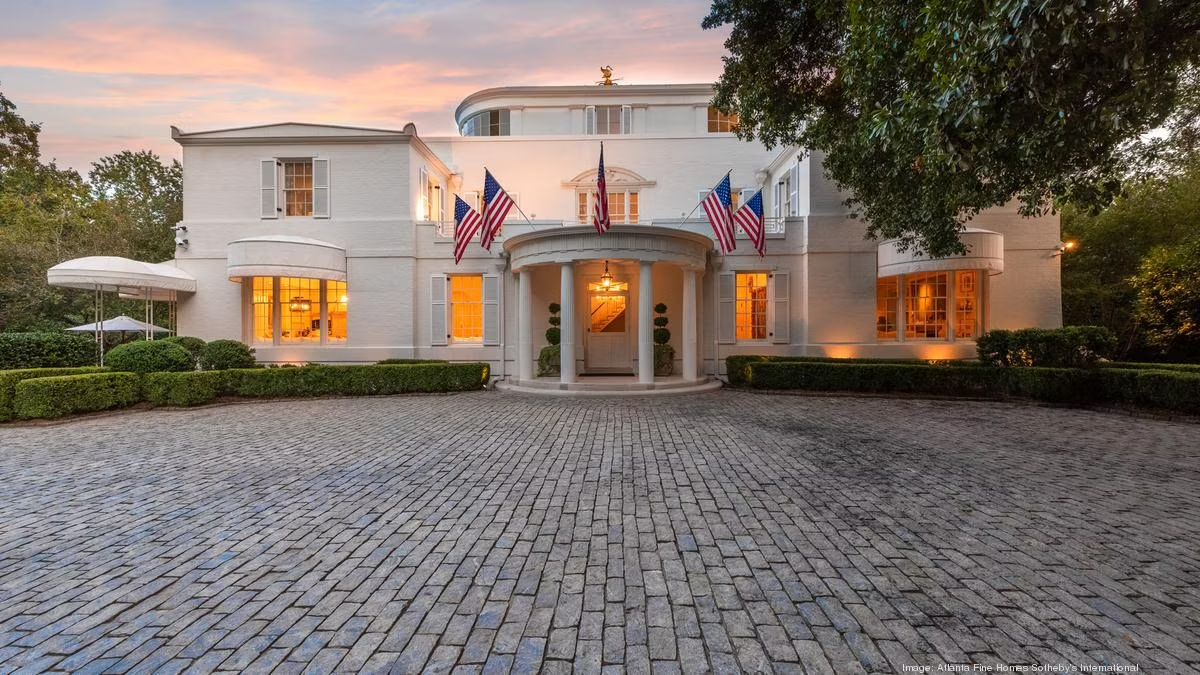
The borrower owns a 9,903 square-foot historic Colonial estate on 4.39 gated acres in Buckhead, one of Atlanta's most prestigious neighborhoods. Built in 1937, the property has been transformed into the operational hub of an event and media production business generating over $200,000 per month in revenue: weddings, corporate programming, and film and television productions.
The equity in the estate had been sitting idle while the business it housed kept scaling. The borrower needed to pull approximately $400,000 cash out of the asset to fund purchase contracts on additional properties approaching maturity and to deploy capital improvements across an existing portfolio. Every week the equity stayed trapped in the estate was a week it wasn't working.
The urgency was real. The borrower had purchase contracts with hard deadlines. Missing the close window meant forfeiting deposits and walking away from the next acquisitions in the pipeline. That calculus was further complicated by the fact that another lender had already been working the same file and failed to execute. By the time this deal arrived at Brick City Capital, weeks had already been burned and the runway was shorter than it should have been.
No Comparable, No DSCR Coverage, and an Income Stream Most Lenders Can't Qualify
Three layers of complexity stacked on this file. First: a 9,900 square-foot historic Colonial built in 1937 on 4.39 gated acres in Buckhead is not an asset most non-QM rate sheets price cleanly. There is no comparable. The as-is value was ultimately supported at $4,800,000, but getting there required two independent appraisals, not one.
Second: the property's market rent, first reported at $15,000 per month and later supported at $30,000 per month on a second appraisal, cannot cover debt service on a $3.1M loan under any standard DSCR underwrite. At either rent figure, the coverage math doesn't work. A lender who evaluates this deal through a DSCR lens hits a wall immediately and has nowhere to go.
Third: the income that actually services this property is not a residential lease. It is event and production revenue, $200,000 or more per month, flowing through a business operating account. That cashflow is real, substantial, and fully documentable. It is also periodic and irregular in its timing, which means it doesn't fit any DSCR rent-comp framework regardless of how it's modeled.
Income Underwriting Approach
Required DSCR to qualify. Market rent at $15K–$30K/month could not cover debt service on a $3.1M loan. Deal dead at the rent comp.
Appraisal Strategy
Would have required new appraisals ordered from scratch under their guidelines, adding weeks and producing the same dead end the prior lender already hit.
Timeline Impact
Prior lender stalled at DSCR test with weeks already burned. Borrower arrived at Brick City Capital with real acquisition deadlines closing in and no margin for another slow execution.
DSCR Coverage
< 1.0
Deal Declined
Income Underwriting Approach
12-month business deposits averaging $200K+/month measured actual repayment ability, not a rent figure that was never going to work.
Appraisal Strategy
Transferred the existing appraisal from the prior lender's file to save time and cost, then ordered a second appraisal independently. Both confirmed as-is value at $4,800,000.
Timeline Impact
All workstreams ran simultaneously. Appraisal transfer, second appraisal, bank statement analysis, entity review, and payoff coordination ran in parallel from day one. 24 days from intake to funding.
Resulting Income Model
65% LTV
$3.1M Funded
Have a luxury or unique-use property that didn't survive a DSCR test at another lender?
Estate-grade assets, event venues, film locations, and business-operated properties require a different underwriting lens. Submit your scenario and we'll tell you what we see.
Holistic Underwriting & Parallel Execution
The critical decision on this file was made at intake, before any work began: this was a bank statement deal, not a DSCR deal. The property was never going to cover debt service on market rent, and the prior lender proved it. Spending more time trying to force a DSCR answer on a business-income asset was not a path to closing. It was a path to the same result the previous lender produced.
Pivoting to a 12-month bank statement underwrite meant evaluating the borrower against the income that actually services the loan. The business operating account showed consistent monthly deposits well in excess of debt service. The cashflow was real. The repayment ability was there. The DSCR question stopped being the gating issue entirely.
With the underwriting program confirmed, every remaining workstream ran simultaneously. There was no sequential process on this file. Nothing waited for anything else to finish before it started.
DAY 1
Bank Statement Program Identified, Appraisal Transfer Evaluated, Entity Structure Reviewed
At intake, the file was classified as a bank statement deal. The existing appraisal from the prior lender's file was evaluated for transfer. Entity documentation and payoff structure reviewed simultaneously. Existing title relationship maintained to eliminate a full new title chain workup.
DAYS 2–12
12-Month Bank Statement Analysis, Second Appraisal Ordered, Payoff Coordinated
Bank statements reviewed across 12 months of business operating account deposits consistently over $200,000 per month. Second appraisal ordered independently to confirm as-is valuation. Payoff coordination with the prior lender's title company initiated in parallel to prevent any delay at close.
DAYS 13–20
Both Appraisals Confirmed Value, Underwriting Cleared
The transferred appraisal and the newly ordered second appraisal both supported the as-is value at $4,800,000, confirming the 65% LTV needed for the loan amount. Bank statement analysis supported repayment ability. Underwriting cleared both the asset and the borrower without a program change or restructure.
DAY 24
$3.1M Cash-Out Refinance Funded
✓ $3,100,000 funded — 30-year fixed, bank statement underwrite, no program change
✓ 65% LTV against $4,800,000 as-is appraised value
✓ ~$400,000 cash at closing deployed into pending acquisitions and portfolio improvements
✓ Estate's equity now actively working across the borrower's portfolio
✓ Business operations at the property continue uninterrupted
Real Income Is Repayment Ability, Even When the 1007 Says Otherwise
The DSCR framework exists for a reason. For most investment properties, market rent is the right proxy for repayment ability: stable, comparable, and independent of who owns the asset. But a 1937 estate in Buckhead that hosts weddings, corporate events, and film productions is not a property where the 1007 rent schedule tells the full story. Evaluating it as if it were produces a guaranteed dead end, as the prior lender demonstrated.
The borrower's business generated over $1.7 million in revenue last year running through the same operating account that services this loan. That income is documentable, consistent, and meaningful. A bank statement underwrite measures what's actually there rather than what a comparable unit in the market might hypothetically rent for. In this case, those two numbers produce entirely different outcomes.
Estate-grade, unique-use, and business-operated properties are not rare. There are luxury assets across every major market being underutilized because the lenders reviewing them only know how to look through one lens. When the cashflow is real and the borrower's track record is strong, there is usually a path. It just requires underwriting the full picture.
$400,000
Cash deployed at closing. Growth capital that had been sitting idle in a single asset for years.
Meet the Loan Officer
.webp)
"This deal came down to underwriting the borrower, not just the rent comp and recognizing that real, documentable business income running through a property is repayment ability even when the 1007 says otherwise."
WHO SHOULD BRING US DEALS LIKE THIS
"Doesn't Qualify" at One Lender Doesn't Mean the Deal Is Dead
Brokers and advisors working with high-net-worth borrowers whose properties don't fit a clean DSCR box
Luxury estate-grade assets, historic properties, and unique-use real estate frequently carry strong equity and strong borrowers but don't clear a standard DSCR screen. If your client's income is real and documentable and the lender's only tool is a rent schedule, the file needs to move to a different desk.
Owners of event venues, film and production locations, private clubs, or hospitality assets
Properties that generate revenue through business operations rather than residential leases require bank statement or business income underwriting. The income is there. The issue is finding a lender who knows how to measure it.
Anyone whose deal stalled at another non-QM lender after the DSCR test
The prior lender's failure doesn't mean the deal is undoable. It often means the file was brought to the wrong program. If the borrower has real cashflow, real reserves, and a real asset, there is frequently a path forward, and a compressed timeline after a failed close doesn't have to mean the deal is dead.
Borrowers with pending acquisition contracts who need certainty of execution
When purchase contracts are approaching maturity and deposits are on the line, the margin for another stalled close is zero. Bring the file early, give us the full picture, and we'll tell you quickly whether there's a path and what it looks like.